|
Municipal
solid waste contains a large volume of organic materials, which are recyclable
and economical of waste. Whatever the organic wastes are collected separated
or not; it is possible to produce fertilizer of acceptable quality by
adopting the appropriate procedure.
We provide
two technologic methods to disposal organic waste, anaerobic digestion
and aerobic digestion. Due to the very strict quality control of the compost
produced, the high quality fertilizer can be used for different soil improvement
applications, such as agriculture and forestry, horticulture, landscaping
and soil industry.
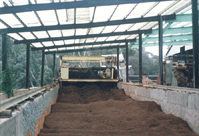 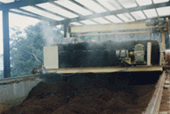
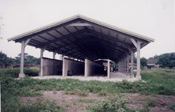
Choice 1. Anaerobic digestion
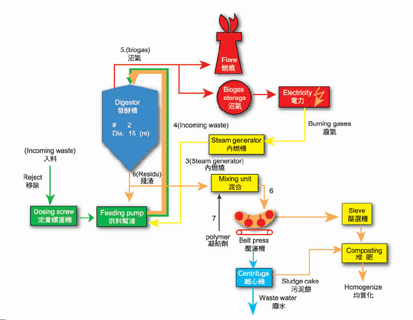
Anaerobic digestion
occurs under conditions with deficient oxygen, an anaerobic digestion
installation typically consists of the following process: pre-treatment,
digestion, post-treatment of the residue and utilization of the biogas,
This biogas can be combusted directly in modified gas boilers or can be
used to run an internal combustion engine, for example, the biogas can
be converted into electricity and heat in a combined heat and power unit,
the additional benefit creates more competitive advantage on economic.
Anaerobic digestion is suitable for numerous organic wastes, such as sewage
sludge, livestock wastes and manure.
Choice 2. Aerobic digestion
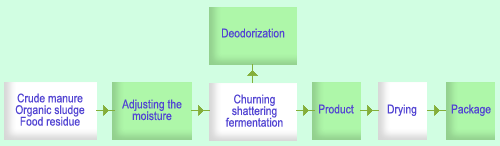
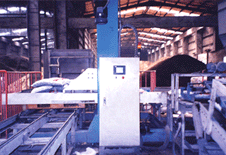
Aerobic digestion treatment system comprises a pre-treatment
section, a composing section, and a compost refinement section. The process
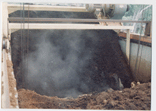
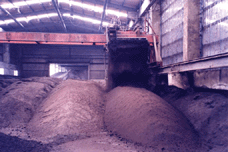
is under conditions with oxygen supply, there is various outdoor and indoor
systems can be applied for the composting of the pretreated biowaste,
for example, windrows, hangar composting, or tunnel composting.
|
|
Certain types
of household wastes are also hazardous include old batteries, shoe polish,
paint tins, old medicines, and medicine bottles. In the industrial sector,
the major generators of hazardous waste are the metal, chemical, pesticide,
dye, refining, and rubber goods industries. Hospital wastes are generated
during the diagnosis, treatment, or immunization of human beings or animals
or in research activities in these fields or in the production or testing
of biological.
Industrial and hospital wastes
are considered hazardous as they may contain toxic substances, which could
be highly toxic to humans, animals, and plants. In order to avoid infection,
hazardous and hospital waste should be treatment separated with other
waste.
The technologic treatment system can disposal the hazardous and hospital
waste in high-temperature gassing process for materials of any kind. It
easy integration into the existing infrastructure, for example, in industrial
areas, a better energy utilization by power-heat coupling adjusting to
the existing demand for close and long-distance heat supply, energy supply
demand.
|


